
HRW Banner NEW 2

Forced labour remains one of the most severe and complex human rights risks in global supply chains. Across sectors and geographies, companies face increasing scrutiny — from regulators, enforcement authorities, investors, civil society and affected rightsholders — to demonstrate that risks are identified, addressed and remediated in practice.

This hub brings together insights on forced labour risk, enforcement dynamics and business preparedness, drawing on emerging regulations such as the EU Forced Labour Regulation (EUFLR) alongside other modern slavery and forced labour frameworks.
Why forced labour is a business-critical risk

  • Forced labour risks exist across all regions and sectors, including manufacturing, agriculture, construction, logistics, fishing and services.
  • Risks are often embedded across complex supply chain networks, particularly where subcontracting, recruitment intermediaries or informal labour are involved. Failure to identify risks is increasingly interpreted as a due diligence gap — not proof of a risk-free value chain.
  • Enforcement is shifting from disclosure expectations to market access restrictions, product bans and investigations.
  • Unmanaged forced labour risks expose companies to loss of customers, restricted market access, regulatory penalties, investor scrutiny and reputational damage — making robust due diligence a commercial and strategic necessity.

“If companies are not identifying forced labour risks in their supply chains, this often indicates that their human rights due diligence is not yet risk-adequate.”

What constitutes forced labour?

The International Labour Organization (ILO) estimates that 27.6 million people are currently in forced labour, with 17.3 million in the private sector.

ILO Convention No. 29 defines forced labour as:

“All work of service which is exacted from any person under the menace of any penalty and for which the person has not offered themselves voluntarily.”

Forced labour is determined by the presence of three core elements.

Forced labour is not limited to formal jobs or recognised employment. It can occur in informal work, seasonal labour, subcontracted activities, and even situations not typically seen as “work”, such as forced begging or compulsory community labour.

A person is kept in the work through fear of negative consequences. This does not have to mean physical violence. Penalties can include:

  • Financial punishment or debt
  • Threats of dismissal or loss of income
  • Legal consequences or immigration-related risks
  • Loss of housing, food, or access to basic services

What matters is how threatening the situation feels to the worker, not how severe it may appear from the outside.

Forced labour exists where a person:

  • Never truly consented to the work, or
  • Cannot leave the job freely when they want to

This means forced labour can occur even if a contract was signed or the job was initially accepted. If someone feels they cannot walk away without serious consequences, the work is not genuinely voluntary.

  • Abuse of vulnerability or deception
  • Restriction of movement or isolation
  • Abuse of vulnerability or deception
  • Threats or intimidation
  • Retention of identity documents
  • Withholding of wages or debt bondage
  • Excessive overtime
  • Abusive working or living conditions
The presence of multiple indicators increases the likelihood of forced labour.

State-imposed forced labour: harder to detect, different dynamics

The 2025 revised edition of the ILO forced labour indicators added a dedicated section on identifying state-imposed forced labour, recognising that this practice’s specific characteristics make it even harder to detect than exploitation in private settings.

Unlike private sector forced labour, the compulsion comes directly from national laws, policies or official orders rather than individual employers or recruiters. The key question becomes whether the state’s requirement to work exceeds what international labour conventions permit.

State-imposed forced labour can take various forms, including:

  • Compulsory labour as political punishment
  • Mobilisation for economic development
  • Labour discipline measures
  • Punishment for striking
  • Discriminatory practices based on race, religion or social status

Forced labour is a global risk, not a local exception

Forced labour is not limited to specific countries or industries. While certain sectors are recognised as higher risk, forced labour can occur at any stage of global value chains — from raw material extraction to manufacturing, logistics and services.

This is why identifying forced labour risks requires risk-adequate human rights due diligence, grounded in context, worker perspectives and real-world indicators.

The regulatory and enforcement landscape at a glance

Governments are increasingly using trade, customs and market surveillance tools to prevent goods made with forced labour from entering their markets. These measures complement — and increasingly test — companies’ human rights due diligence systems.

European Union Forced Labour Regulation (EUFLR)

  • Introduces a product-based market prohibition on goods made with forced labour
  • Applies to all companies placing goods on or exporting from the EU
  • Covers all products and all stages of production
  • Applicable from 14 December 2027
  • Focuses on investigations, evidence and enforcement, with authorities assessing due diligence steps, mitigation measures and traceability information

United States Uyghur Forced Labor Prevention Act (UFLPA)

  • Creates a rebuttable presumption that certain goods are made with forced labour, requiring a high evidentiary threshold for import
  • Customs enforcement: Trade tools such as Withhold Release Orders are increasingly used to block goods at the border

Risk-based due diligence laws

  • EU’s CSDDD, Germany’s LkSG, France’s Duty of Vigilance and Norway’s Transparency Act require companies to identify and address severe human rights risks, including forced labour, across their value chains
  • Across jurisdictions, expectations are converging around credible risk identification, traceability and defensible evidence — not just policies or statements

Modern slavery reporting laws

  • UK, Australia, Canada: Require large companies to publish annual statements or reports on forced labour and child labour risks in supply chains
  • While reporting-focused, these regimes are increasingly scrutinised by regulators, investors and civil society for substance and credibility

How businesses can identify and reduce forced labour risks

Companies should proactively assess whether their existing human rights due diligence systems are prepared to identify and reduce forced labour risks. Recommended steps include:

  • Identify the forced labour–related regulations relevant to your company, activities and markets, and clarify how they apply across your value chain (e.g. EU Forced Labour Regulation, CSDDD, national modern slavery laws, import bans).
  • Conduct a gap analysis of existing policies, processes and controls to assess alignment with the relevant forced labour regulatory requirements.
  • Develop a targeted action plan to close identified gaps and integrate forced labour requirements into broader human rights due diligence processes.
  • Strengthen monitoring systems to better identify higher-risk suppliers, products and geographies.
  • Undertake enhanced due diligence in high-risk contexts or where supply chain visibility is limited.
  • Implement mitigation measures, prioritising supplier engagement and remediation, while also enabling responsible disengagement where risks cannot be effectively addressed.
  • Build crisis preparedness, ensuring the organisation can respond quickly and credibly to allegations, investigations or regulatory inquiries.

Explore our insights on forced labour risks

  • Tune into the podcast episode between our managing director, Markus Löning, and Marco Felsberger, Senior Advisor for Supply Chain Resilience at Prewave, as they unpack the realities of forced labour in today’s global value chains, and what actionable steps organisations can take to protect both people and profits.
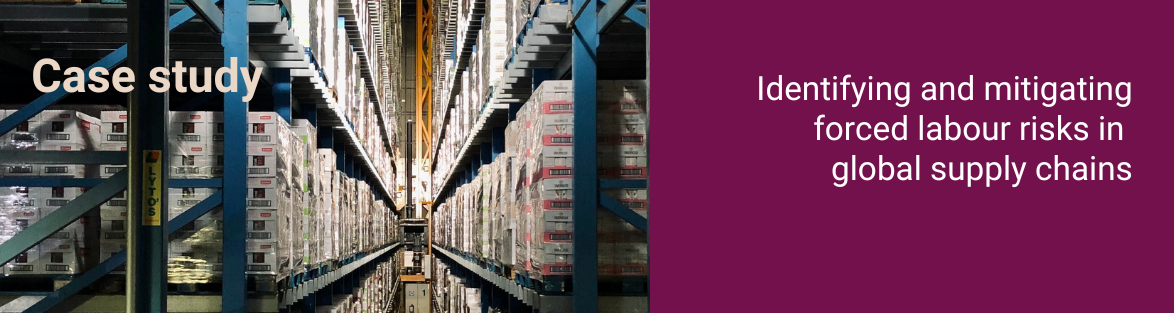
  • Case study on how Löning helped a leading heavy machinery company identify and address potential forced labour risks across their supply chain.
  • Briefing Paper gives you an overview on what the EU Forced Labour Regulation means for your business, key compliance requirements, and how to prepare effectively.

How we support companies

We are an international management consultancy specialising in human rights. For more than a decade, we have advised over 100 companies across sectors on strengthening human rights due diligence and managing complex value-chain risks — including high-risk commodities, suppliers and difficult-to-access regions.

We support companies with clear oversight and defensible decision-making by providing:

icon-splat-research

Material risk identification and focus
Identifying where the company’s most severe human rights risks are likely to arise across suppliers, tiers, and indirect business relationships.

icon-splat-search

Credible and defensible risk analysis
Combining context-specific research, advanced screening tools, and independent expert validation to assess forced labour and severe human rights risks across complex value chains.

icon-splat-wayfinding

Risk prioritisation and escalation
Applying a structured severity-and-likelihood framework to distinguish risks requiring routine management from those requiring enhanced due diligence or executive attention.

icon-splat-cycle

Decision-ready insights
Delivering concise, actionable recommendations aligned with the company’s leverage, risk appetite, and strategic priorities to support effective oversight and leadership decisions.

Contact us

    Request Information


    I would like to learn more about managing forced labour risks in global value chains.

    Contact us
